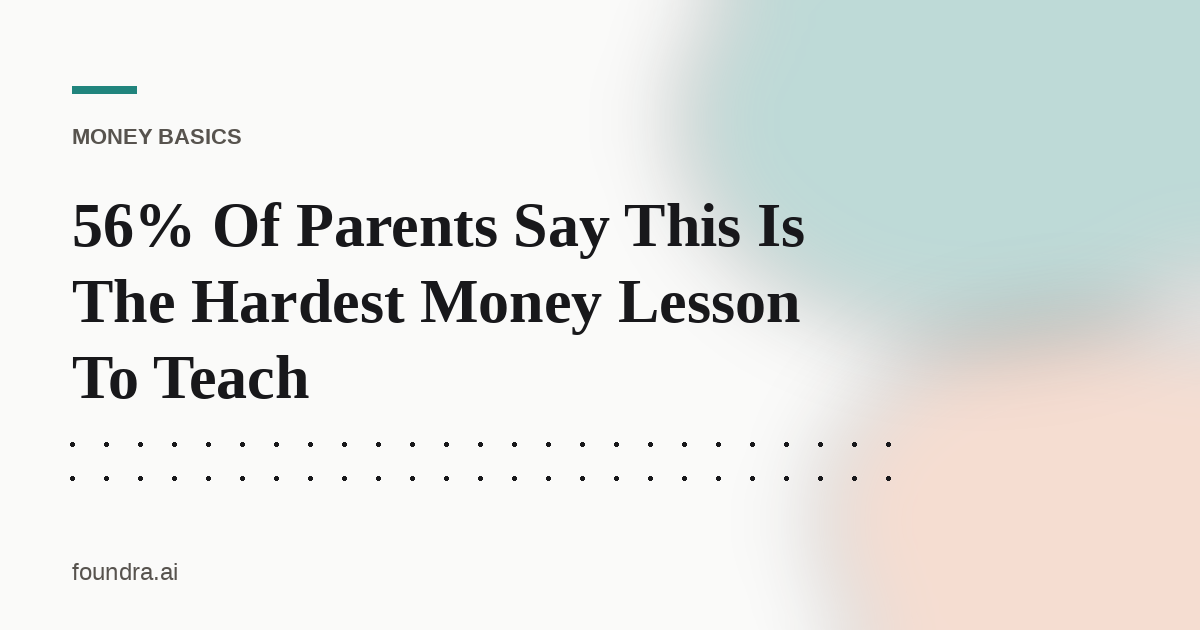
56% Of Parents Say This Is The Hardest Money Lesson To Teach
A new survey of parents and grandparents found the toughest thing to teach kids is not budgeting or investing. It is not buying the thing. Here is why impulse control is so hard to pass on, and five ways to practice it that do not involve a lecture.
What did the new survey actually find?
Wealth Enhancement surveyed 1,000 US parents and grandparents for a study it calls The First Dollar. The headline is a little bleak: 53% believe children today are less prepared to manage money than they themselves were at the same age. Grandparents and boomers were the most pessimistic. Millennials were the least.
But the more useful finding is buried a layer down. When asked which money lesson is hardest to teach, 56% picked avoiding impulse purchases and overspending. Budgeting and everyday spending came second at 52%. Understanding how money is earned and the value of work came third at 50%.
So the thing parents struggle with most is not a math skill. It is a self-control skill.
That matters because almost all the money content aimed at families teaches the math. Save some, spend some, give some. Compound interest. Needs versus wants. Those are fine and kids should learn them. But none of them is the thing that stops a nine-year-old from spending twelve dollars on a mystery box at 8pm on a Tuesday.
Why is impulse control harder to teach than budgeting?
Because budgeting is knowledge and impulse control is practice.
You can explain a budget in ten minutes. A kid can repeat it back and get it right. Then they walk into a store and the explanation does nothing, because the part of the brain doing the wanting is not the part that listened to you.
The prefrontal cortex, which handles planning and delayed gratification, keeps developing into the mid-twenties. Expecting a ten-year-old to reason their way out of a want is asking a system still under construction to do heavy lifting. This is developmental, not a character flaw, and treating it as one is how kids learn to hide their spending instead of talking about it.
There is a second problem. Modern spending has almost no friction left in it. When money was cash in a wallet, the transaction had physical steps: count it, hand it over, watch the wallet get thinner. Now a saved card and a face scan turn a want into a purchase in under three seconds. The pause where a kid might reconsider has been engineered out on purpose.
So you are not teaching against your child's nature. You are teaching against a product designed to remove exactly the moment you are trying to create.
Does giving an allowance help?
Most families think so. In the survey, 68% of parents and 58% of grandparents said they give their children an allowance. Respondents put the right starting age somewhere between 5 and 12, with 8 the most common answer. Parents named $21 a week as a fair amount on average. Grandparents said $15.
Research generally supports the idea that having money to manage builds financial capability, though the effect depends on how it is done. A study in the Journal of Financial Literacy and Wellbeing looking at childhood allowances in Japan found measurable links between receiving an allowance and later financial literacy and attitudes toward money.
The practical version: an allowance only teaches impulse control if the child can actually make a bad decision with it and feel the result. An allowance that gets topped up whenever it runs out teaches the opposite lesson, efficiently.
One more data point from the same research roundup. A Wells Fargo study found 51% of parents reward academic performance financially, roughly twice the rate of any other behavior. Which means most kids' first experience of earning is tied to grades rather than to work, effort, or delivering something somebody wanted.
Five ways to practice the pause at home
None of these require a lecture. All of them create the moment that got engineered away.
The 48-hour list. Anything over a set amount, say $15, goes on a list on the fridge instead of into a cart. After two days, if they still want it, they buy it. Kids abandon a startling share of those items without any adult saying no. The parent never becomes the villain. The waiting does the work.
Cash for one category. Pick something they buy often, snacks, game currency, small toys, and make that category cash only. Handing over paper restores the friction that tap-to-pay removed. Keep everything else digital if you want; one category teaches the feeling.
The unit price game. In a store, ask them to work out which option costs less per item or per ounce. It sounds like math homework and it is, but the side effect is a few seconds of thinking between wanting and buying. That gap is the entire skill.
Name the trigger out loud. After a purchase they regret, ask what happened right before. Bored? Tired? A friend had one? Kids are often startlingly accurate about this when nobody is scolding them.
Let a bad purchase stand. This is the hardest one for parents. If a child spends their own money on something disappointing, resist rescuing them. The five-dollar lesson at nine is astronomically cheaper than the five-thousand-dollar version at twenty-two.
How do you handle the digital wallet problem?
You cannot put the friction back by pretending phones do not exist. But you can rebuild some of it.
Turn off saved cards on the devices your kid uses. Typing the number each time reinstates about twenty seconds of thought, and twenty seconds is often enough.
Use the approval features that already exist. Most family payment and banking apps let a parent see or approve transactions. Send the notification to your phone too, and talk about the ones that surprise you rather than silently blocking them.
Separate the accounts. Spending money and saving money should not sit in the same balance, because a single number invites raiding.
And say the quiet part directly: this app was designed to make buying easy, and that is not an accident. Kids respond well to being let in on how something works. It reframes the pause as being smart rather than being restricted, which is the difference between a habit that survives adolescence and one that ends the day they get their own account.
What if your kid earns their own money?
Then you have the best possible teaching material and you should use it carefully.
A kid running a lawn business, selling on a marketplace, or getting paid for tutoring learns something an allowance cannot deliver: the connection between hours and dollars. When they know a purchase costs three hours of raking, the arithmetic changes on its own. No lecture required.
The mistake is taking over the money. Parents who direct every dollar of a child's earnings turn a business into a chore. Give the earned money a structure instead. A common split is roughly half to spend freely, a third to a longer-term goal, and the rest to something they choose to give. The exact percentages matter less than the fact that the child picked the goal.
It also helps to track the business somewhere real. A shared spreadsheet, a paper notebook, or a planning tool like Foundra all work equally well for recording what came in and what it cost. The habit of separating revenue from profit is the lesson; the tool is not.
And let the goal be something you consider silly. A kid saving eleven weeks for a hoodie you would never buy is doing more real financial work than one saving for something their parents approved of. Approval is not the point. Practice is.
Key takeaways
- In Wealth Enhancement's First Dollar survey of 1,000 parents and grandparents, 56% said avoiding impulse purchases is the hardest money lesson to teach, ahead of budgeting at 52% and the value of work at 50%.
- 53% believe kids today are less prepared to manage money than they were, with grandparents most pessimistic and millennials least.
- 68% of parents and 58% of grandparents give an allowance. Age 8 was the most common starting point, with parents naming $21 a week and grandparents $15.
- Impulse control is a practice skill, and the brain systems behind it keep developing into the mid-twenties.
- Digital payments removed the pause between wanting and buying. Cash for one category and a 48-hour list put some of it back.
- Let small bad purchases stand. A five-dollar regret at nine is the cheapest tuition available.
- Earned money teaches the hours-to-dollars link that allowance cannot.
Frequently asked questions
What age should we start an allowance?
Survey respondents landed on 5 to 12, with 8 the most common answer. The better test is readiness rather than birthday: if a child can count money, wait a short time for something they want, and understand that spending it here means not spending it there, they are ready.
How much allowance is right?
Parents in the survey averaged $21 a week and grandparents $15, but the principle matters more than the number. The amount should be large enough that choices have consequences and small enough that a mistake is survivable.
Should allowance be tied to chores?
Families split on this and both approaches work. Tying it to chores teaches that money follows effort. Keeping it separate teaches that some contributions to a household are simply expected. A middle path many families like: a baseline allowance that is not earned, plus paid extra jobs available on request.
Is it bad to pay kids for good grades?
A Wells Fargo study found 51% of parents do it, about twice the rate of any other rewarded behavior. Research on the effects is mixed, and the main worry is that external rewards can crowd out a child's own interest in learning. If you do it, many families prefer rewarding effort and habits over the letter on the report card.
My child spends everything the moment they get it. Is that normal?
Entirely normal, especially before about age ten. The fix is structure rather than persuasion. Split the money into separate places on arrival, keep a waiting rule for larger purchases, and give it time. Talk about your own decisions out loud too, including the ones you got wrong. Kids absorb anxiety much faster than they absorb rules.
Sources
- Survey finds older generations worried about kids' financial literacy (ABA Banking Journal)
- The First Dollar: Kids' Financial Preparedness (Wealth Enhancement)
- New research shows how well families prepare kids from piggy banks to portfolios (Stacker)
- Allowance Accounts and Digital Tools for Kids (Wells Fargo)
- How childhood allowance affects financial literacy and monetary attitudes (Journal of Financial Literacy and Wellbeing, Cambridge)
Ready to help a young entrepreneur get started?
Foundra Kids gives young founders a simple, fun way to plan their first business.
Try Foundra Kids