One In Ten Paying Teens Covers Two Thirds Of The Money. That Is The Business Model.
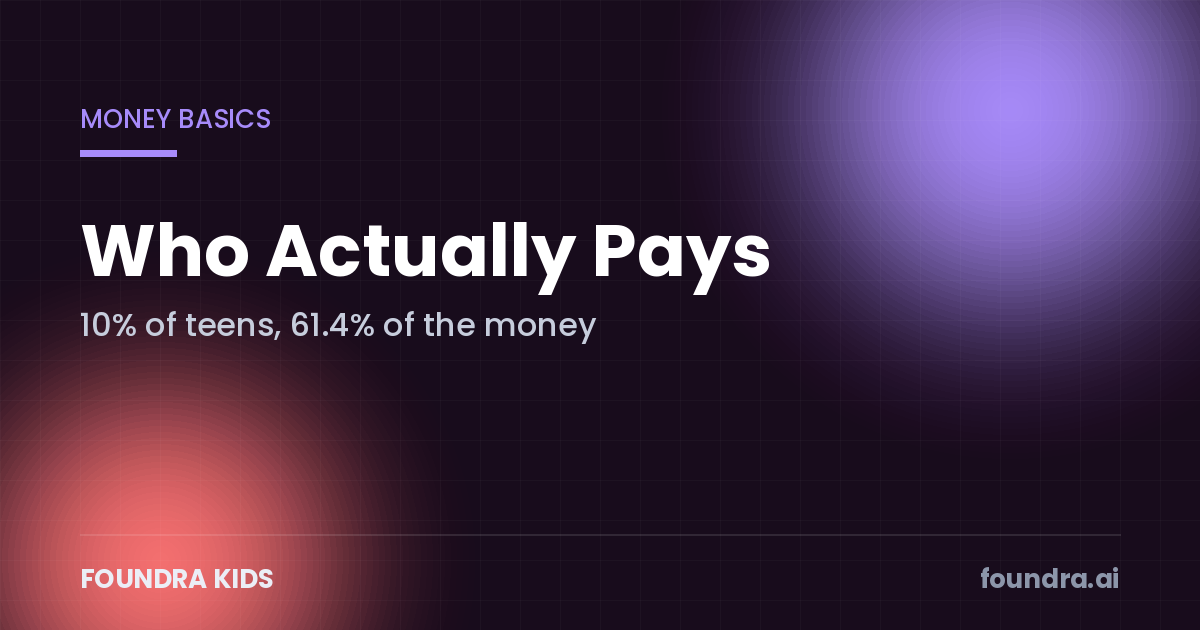
A new study of 2,308 students found that among teens who spent anything inside games, the top 10% accounted for 61.4% of all the money. The distribution was almost as uneven as gambling. Family income did not predict who ended up in that group.
The number that explains the whole industry
Researchers led by Markus Meschik at UAS St. Polten in Austria surveyed 2,308 students aged 10 to 19, handing questionnaires out in class rather than online. Of those students, 818 said they had put money into a game in the previous twelve months. Their combined reported spending came to about 139,000 euros, roughly $162,000.
Then the distribution. The 85 biggest spenders, 10.4% of the payers, accounted for 61.4% of all the money. Each of them reported somewhere between 400 and 12,000 euros over the year, averaging about 1,005 euros, roughly $1,174.
Set that against income. The typical student in the survey reported receiving about 50 euros a month, around $58. The average heavy spender put twenty months of that income into games in a single year.
Free-to-play games are free to install. The money arrives afterward, through what the industry calls microtransactions. And the economy does not run on a crowd of players each spending a little. It runs on a small group spending a great deal. That is not an accident of consumer behavior. It is the design target.
The gambling comparison is not rhetorical
The researchers measured how unevenly the spending was distributed using a Gini coefficient, the standard tool for measuring inequality, where zero would be a perfectly even split.
In-game spending among these teenagers scored 0.854. German gambling spending, measured the same way in earlier research, came out at 0.879. Those numbers are close enough to be the same phenomenon.
The two industries are not regulated anything alike. Meschik put the asymmetry directly: in gambling, governments have taken substantial responsibility for protecting consumers, while in gaming much of that responsibility is still left to parents.
That is the situation you are in. The product is engineered by teams with revenue targets and behavioral data, and the designated safeguard is you, at the kitchen table, with whatever you happen to know about how it works. So here is how it works.
Family income did not predict who spent heavily
The researchers expected the biggest spenders to come from wealthier families. They did not.
Each household received a score on a standard family affluence scale asking about cars and family holidays. Heavy spenders averaged 9.58 out of 13. Everyone else averaged 9.71. The two groups were effectively identical.
When age, sex, family wealth and gaming disorder symptoms were tested together, three of the four predicted who became a heavy spender. Family wealth was the one that did not.
Meschik's summary: players from financially and socially disadvantaged backgrounds were just as likely to become heavy spenders as those from more affluent backgrounds, which challenges the idea that very high spending simply reflects disposable income.
For a parent this removes a common piece of false comfort. "We do not have that kind of money" is not protection. The heavy spenders in this study did not have that kind of money either. They spent it anyway.
It peaks at fifteen and sixteen
Across everyone who paid anything, the average was about 170 euros over the year, roughly 14 euros a month. Boys averaged about 181 euros, girls about 102.
The age pattern surprised the researchers. They assumed older teenagers, with more money available, would spend more. Instead 15 and 16 year olds spent the most, averaging about 216 euros, and the 17 to 19 group spent less.
The authors read the peak as the stretch when gaming matters most to a teenager's friendships and to their sense of who they are. That fits what we know about adolescence more broadly, where risk-taking peaks early and tapers through the twenties.
The parenting implication is specific. The highest-risk window is not late high school when your kid has a job and a debit card. It is ninth and tenth grade, when the spending is socially motivated, each amount feels small, and you have probably relaxed supervision because the tablet-monitoring years are behind you. That is the window to have the conversation in.
How the money actually leaves the house
The payment data is the most immediately useful part of the study for parents.
Among payers, 63.8% used prepaid cards. PayPal came next at 23.0%. And 17.6% reached for a parent's credit or debit card.
Prepaid cards dominating is worth sitting with. It means most of this spending never shows up on your statement. A gift card bought with allowance or birthday money converts to in-game currency with no trace in any account you monitor. If your check on this is "I would see it," for roughly two thirds of teenagers that is not true.
The second number produces the difficult phone call. Nearly one in five reached for a parent's card. In many countries, consumer protection organizations help families obtain refunds for purchases a child made without permission, and platform refund processes exist for exactly this case. Knowing that before it happens is worth more than knowing it after.
Platforms and consoles already have parental controls and spending limits built in. The study's authors point out that these exist and are underused, which is a polite way of saying almost nobody turns them on.
The mechanics work as a set
Loot boxes have absorbed most of the political attention because they are the most obviously gambling-like element. You pay without knowing what you will receive.
Belgium's gambling regulator classified them as gambling with fines up to 800,000 euros. The Netherlands has planned a ban. Austrian courts have ruled for plaintiffs three times. Publishers largely kept selling them anyway, and more than 80% of Belgium's highest-grossing apps still offer them.
Meschik warns that focusing on loot boxes alone would be a mistake, because the mechanics operate together:
Battle passes create a deadline. Pay now or the season's content is gone.
Daily rewards create a streak you feel you cannot break, which is what turns a game into an obligation.
Virtual currencies hide the real price. Nobody knows what 950 gems costs without doing arithmetic that the interface is designed to discourage.
Matchmaking is often tuned to put a player against opponents who have bought things, which converts frustration into a purchase impulse.
Remove loot boxes and the rest of the system continues working. When Brawl Stars and Overwatch 2 removed them, the rest of their paid design stayed in place.
Friction is the tool that works
The researchers' preferred intervention comes from gambling research, where how often a player can bet predicts how addictive a product becomes. Meschik's suggestion: instead of allowing multiple purchases within seconds, require a waiting period of several minutes between transactions.
You cannot make a game do that. You can install the same idea at home.
A twenty-four hour rule. Anything wanted inside a game gets bought tomorrow, not now. Most in-game purchases are impulse responses to a moment in play, and the moment does not survive a day. This one rule removes a large share of the spending without any argument about whether games are good or bad.
Convert to hours. Before buying, calculate what the item costs in hours of their own work at whatever they earn. A 20 euro skin at 10 euros an hour is two hours. Teenagers are often unmoved by the euro figure and quite moved by the hours figure.
A running total they keep themselves. Not a limit you impose, a number they maintain. Researchers note that people consistently underestimate what they spend, with the error growing as amounts grow. A teenager who tracks their own total discovers this themselves, which lands better than being told.
Foundra Kids has a simple version of the hours-conversion exercise if you want something to work through together rather than deliver as a rule.
When it is more than spending
The students also answered a four-question screen for gaming disorder, which the World Health Organization defines as losing control over gaming until it crowds out other interests for a year or more.
Among heavy spenders, 14.1% scored above the threshold. Among the other payers, 4.2% did. The 43 payers who screened positive for gaming disorder produced 10.3% of all reported spending, and the 32 who screened positive for gambling problems produced 14.7%.
The screening scores still predicted heavy spending after accounting for age, sex and family wealth. This is not simply older boys with more cash.
The study cannot establish which came first. Heavy spending might feed problem behavior, or teenagers already struggling might spend more. Either direction matters, because both make spending a signal worth reading rather than only a budget problem.
If money going into a game is climbing while sleep, school, friendships or interests are shrinking, the conversation to have is not about money. Around 85% of American teens play video games, so the base rate tells you nothing. The change in everything around the playing is the signal.
Frequently asked questions
My kid only buys cosmetic items. Is that safer? Cosmetics are the main product for teenagers and they sit inside the same system of battle passes, currencies and social pressure. The item being cosmetic does not change the purchase mechanics.
Should I just ban in-game purchases? A ban works until it does not, and the prepaid card data suggests it often does not. Supervised spending with a delay rule teaches more and hides less than a prohibition.
Can I get a refund if my child used my card without asking? Often yes. Platform refund processes exist for unauthorized purchases by minors, and in many countries consumer protection organizations assist families with these claims. Act quickly, since refund windows are usually short.
Which controls should I turn on? Purchase authentication requiring a password every time, a spending cap on the platform account, and removal of any stored payment method. Every major platform supports all three.
Is this only a teenage problem? No. Meschik specifically warned against filing it away that way, noting adults are affected too and probably more. If you run the twenty-four hour rule as a household rule rather than a kid rule, it works better and lands better.
Sources
- Heavy spending in video games among adolescents (Meschik et al., Frontiers in Public Health, 2026)
- Just 10% of teen gamers account for most in-game spending (Earth.com, August 22, 2026)
- Addictive behaviours: Gaming disorder (World Health Organization)
- Gaming Safely: Understanding In-Game Purchases and Their Impact on Kids (Family Online Safety Institute)
- Teens and Video Games Today (Pew Research Center)
Ready to help a young entrepreneur get started?
Foundra Kids gives young founders a simple, fun way to plan their first business.
Try Foundra Kids