
What Actually Kills Startups: The 2026 Shutdown Data
New 2026 shutdown data says running out of cash is the last symptom, not the cause. How first-time founders can run a premortem before the market runs it for them.
The autopsy report founders keep misreading
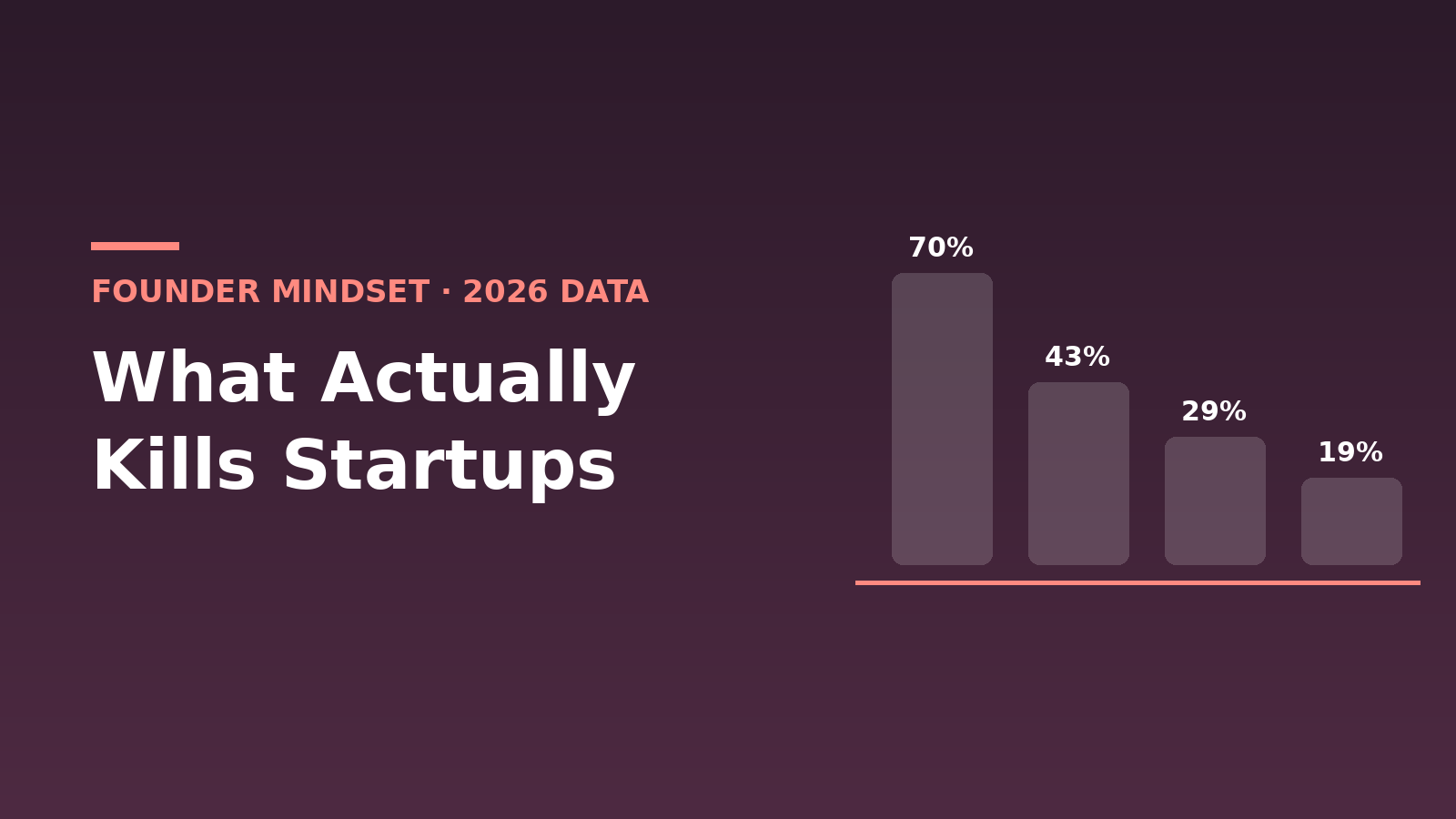
Ask a founder why their startup died and you'll usually hear the same line: we ran out of money. The 2026 numbers back that up, sort of. CB Insights' analysis of VC-backed shutdowns since 2023, widely discussed in July's startup failure coverage, found that running out of capital appeared in 70 percent of cases.
But sit with the rest of the data. Poor product-market fit showed up in 43 percent of those shutdowns. Bad timing in 29 percent. Weak unit economics in 19 percent. The cash didn't vanish on its own. It got spent servicing a product the market had already declined, quietly, months earlier.
That reframe matters more in 2026 than it did in the cheap-money years, because the runway between "the market said no" and "the bank account said no" has gotten short. This article is about reading the shutdown data the useful way: as a premortem checklist for a company that's still alive. Yours.
Why "we ran out of money" is the last symptom
Cash is the scoreboard, not the game. When a startup shuts down, the capital ran out because revenue didn't replace it, and revenue didn't replace it because customers didn't stay, and customers didn't stay because the product never became necessary.
Investors see the same chain. When founders say "we failed because we couldn't raise," what usually happened is that investors declined to keep subsidizing weak retention, confused positioning, or margins that got worse with scale. The refusal to fund is a diagnosis, not a cause of death.
Here's a blunt way to check where you sit on that chain today. If your funding disappeared tomorrow, would customers fight to keep you alive? Would they prepay, make intros, or accept a price increase? If the answer is no, you don't have a fundraising problem waiting to happen. You have a demand problem already in progress, and money would only make it quieter.
Welcome to the soft shutdown era
Startups in 2026 rarely die with paperwork. A European Corporate Governance Institute study found that most failed startups never go through classic bankruptcy. They dissolve through quieter exits: asset sales, talent absorption, or a slow wind-down that never makes the news.
The most visible version is the reverse acqui-hire. Since March 2024, Bloomberg has counted at least six deals where a tech giant hired a startup's founders and star researchers, licensed the technology, and left the company itself behind. Microsoft did it with Inflection. Google did it with Character.AI and Windsurf. Amazon did it with Adept and Covariant. Meta spent $15 billion on Scale AI's core team. In several cases, the employees left behind faced layoffs within months.
For a first-time founder, the lesson isn't that big tech is coming for you. It's that "acquisition" is no longer a reliable safety net. If your plan B is getting bought, understand that 2026 buyers increasingly take the people and the license, not the company. The only durable plan is a business that works on its own.
What failure looks like six months early
Startups fail politely before they fail publicly. The failure analyses this month converge on the same early signals, and none of them show up on a dashboard labeled "dying."
Users call the product interesting but don't change their behavior. Pilots keep extending without converting to paid. Retention sags after the first-use honeymoon. Sales cycles stretch while the team ships more features. Investors keep asking for "a bit more traction." Internal meetings multiply while customer calls shrink. And the pitch keeps changing, because the company still doesn't know what it is.
Any one of these can be noise. Three of them together is a pattern. The founders who survive aren't the ones who never see these signals. They're the ones who respond in weeks instead of quarters, cutting a segment, changing a price, or killing a feature while there's still runway to act on what they learn.
Your AI co-founder is ready when you are.
Foundra turns everything in this article into an actual plan. Validation, customers, pricing, launch. In one place, in your voice, in an afternoon.
Get started→$39/month. Cancel anytime.
Run a premortem this week
A premortem flips the autopsy. Instead of asking "why did we die" after the fact, you assume it's 18 months from now, the company is gone, and you write the honest story of what happened. It sounds morbid. It's the cheapest strategy work you'll ever do.
Do it in three passes. First, write the surface cause: we ran out of money in month X. Second, write the structural cause underneath: which of the big four got us? Weak demand, bad timing, broken unit economics, or a team gap. Third, and this is the hard one, write the behavioral cause: what did we know and ignore, and for how long?
Then turn the story into tripwires. If the premortem says "we kept extending free pilots," set a rule today: no pilot extends past 60 days without payment. Writing this down works better than remembering it. Whether you keep it in a doc or use a structured planning tool like Foundra to map assumptions next to your financial projections, the point is the same: decisions made calmly now beat decisions made desperately later.
The weekly evidence ritual
Premortems decay without maintenance, so pair yours with a short weekly review built on questions that expose truth instead of protecting feelings.
How many real customer conversations happened this week? What did buyers do, not say? What got paid? What got ignored? Which assumption from the premortem got stronger or weaker? And how many months of runway remain at current burn?
Five questions, fifteen minutes, same time every week. The discipline matters more than the format. Teams that skip this drift into what the failure literature calls traction theatre: press mentions, investor meetings, and social engagement standing in for revenue. Activity feels like progress. Evidence is progress.
One more habit worth stealing: track the ratio of customer-facing hours to internal hours across your team. When that ratio falls for three straight weeks, something is being avoided, and it's usually the market.
The AI startup reality check
If you're building in AI, the base rates deserve extra respect. Current industry estimates suggest 70 to 90 percent of AI-focused startups will fail or be acquired at depressed valuations within 18 months. The category is crowded, model costs punish thin margins, and the platform providers keep absorbing features that looked like products a year ago.
That doesn't mean avoid AI. It means the shutdown data applies with the volume turned up. Product-market fit questions hit harder when your differentiation is a prompt away from being copied. Unit economics questions hit harder when every user action has a token cost. And the reverse acqui-hire wave shows that even celebrated AI teams end up as talent deals when the business underneath can't sustain itself.
The founders who clear these odds in 2026 tend to share a shape: they own a workflow, not just a model; they charge in a way that scales with delivered value; and they can name the boring, recurring budget line their product replaces.
Key takeaways
Capital appears in 70 percent of shutdown stories, but product-market fit failure (43 percent), bad timing (29 percent), and weak unit economics (19 percent) are the causes that spend the money.
Acquisition is a weaker safety net than it looks. The 2026 pattern is reverse acqui-hires that take founders and licenses while leaving the company behind.
Failure signals arrive months early and look polite: stalled pilots, soft retention, stretching sales cycles, a story that keeps changing.
Run a premortem now, convert it into tripwires, and hold a weekly evidence ritual so the tripwires actually fire.
If you're in AI, all of the above applies at higher stakes. Own a workflow, price against value, and know which budget line you replace.
FAQ
What is a startup premortem? A planning exercise where you assume the company has already failed at a future date and write the story of why. It surfaces risks while they're still cheap to fix, unlike a postmortem, which arrives too late to help.
Is running out of money ever the real cause of failure? Occasionally, such as when a market shock closes funding windows overnight. But in most 2026 shutdowns, cash exhaustion followed months of weaker signals the team saw and deferred.
How much runway should trigger alarm? A common rule: begin serious corrective action, cuts, pricing changes, or a raise, at 12 months of runway, not six. Options shrink fast below that line, and desperation prices poorly.
What's the difference between a pivot and denial? A pivot follows evidence toward observed demand: customers pulling you somewhere adjacent. Denial changes the story without changing the evidence. If your pitch changed twice but your retention didn't, that's denial.
Should I take a reverse acqui-hire offer if one comes? That's a personal and legal question as much as a business one, and outcomes for non-founder employees have often been rough. Get independent counsel, and negotiate for the whole team, not just the names in the deal memo.
You just read the theory. Ready to build the thing?
Foundra is your AI co-founder. It turns an idea into a validated business plan, a go-to-market, and your first 10 customers. In an afternoon, not a semester.
$39/month. Cancel anytime. Works in 20 languages.