Nadella Says One AI Vendor Is a Trap. He's Not Wrong.
Microsoft's CEO says companies that hand everything to one AI lab won't survive. Here's what that warning means for a small startup, and what to change this week.
What did Nadella actually say?
On Sunday, Microsoft CEO Satya Nadella went on CNN's Fareed Zakaria GPS and repeated a warning he first made in mid July, then pushed it further. Companies that rely wholly on the big proprietary AI labs for their AI needs, he predicted, ultimately won't survive.
"Any firm that doesn't have this control, I will claim will not remain a firm because you've essentially outsourced your thinking," he said. The control he means is specific: keep the metadata from every model call, keep your context and memory separate from the model, and keep your coding harness separate too, so no single lab owns the way your company works.
Two caveats before you act on any of this. Microsoft is an investor in both OpenAI and Anthropic, and its cloud business sells exactly the kind of alternative infrastructure he's recommending. So yes, the warning is self-serving. And it was aimed at enterprises, not five-person startups. But strip away the vendor motives and there's a real question left sitting on your desk: how much of your company's thinking lives inside someone else's product?
Why should a tiny startup care what Microsoft's CEO thinks?
Because you're more exposed than the enterprises he was talking to, not less.
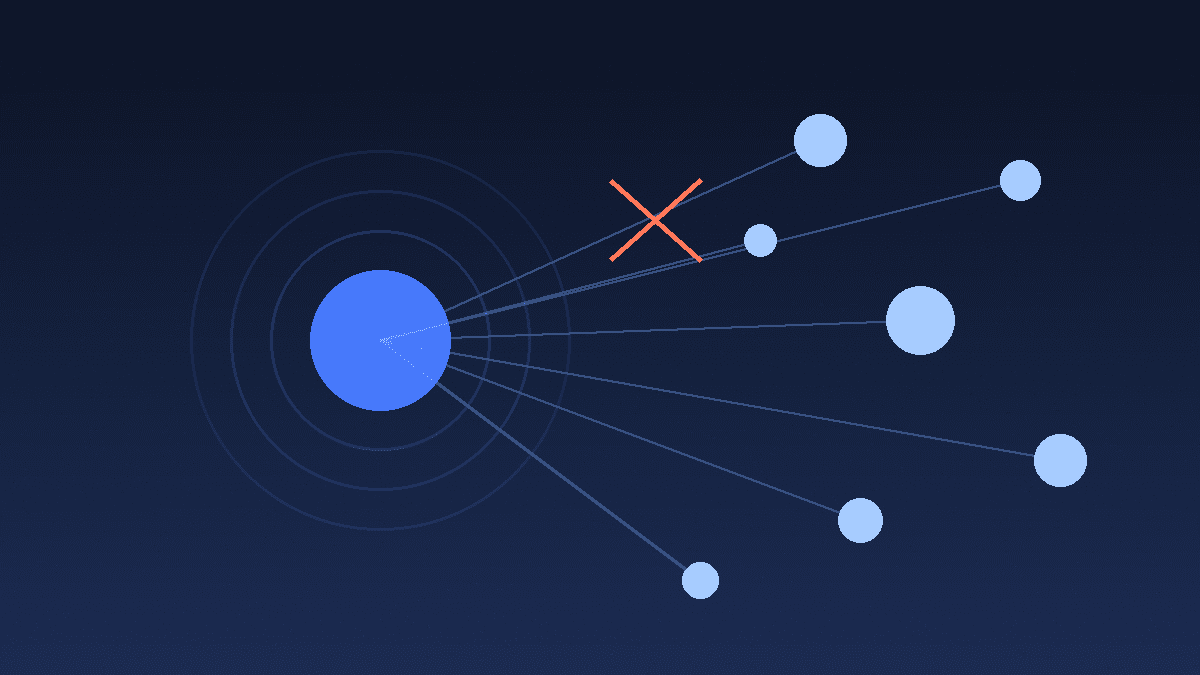
A big company that loses access to a model, or watches prices triple, has lawyers, contracts, and a procurement team to soften the blow. You have a Stripe bill and a prayer. If your product is a thin layer over one API, then your margins, your roadmap, and your uptime are all decisions someone else makes in a meeting you're not in.
And 2026 has already shown how fast the ground moves. Open-weight models caught up enough that enterprises now treat them as real options. Model prices keep shifting. Labs keep launching features that swallow whole categories of startups. The assumption "our AI vendor will stay cheap, stable, and friendly forever" is not a plan.
Here's the useful reframe. Nadella's advice sounds like enterprise architecture, but for a founder it's just risk management: know what you depend on, know what it would cost to switch, and keep the parts of your product that make it yours in your own hands.
What does "outsourcing your thinking" look like in practice?
It rarely looks like a big decision. It looks like a hundred small conveniences.
Your prompts, the ones you spent months refining, live only in one vendor's playground. Your customer conversations flow through one API with no logs kept on your side. Your team's workflows are built around one lab's coding agent, its memory of your codebase locked inside its own system. Your evals and usage patterns accumulate on someone else's servers, teaching someone else's product.
Individually, each choice saved you a day. Together, they mean the switching cost grows every week. That's the quiet trap. Nobody decides to get locked in. They just never decide not to be.
Nadella's suggested posture is worth translating into founder terms. Keep a copy of every prompt and response that matters. Store your own context: the documents, memory, and structure your product feeds into models. Treat the model as a replaceable engine, not the car. The companies that did this in 2025 are the ones shrugging at price changes in 2026. The ones that didn't are doing migrations under pressure.
Could your AI vendor really become your competitor?
It's happened enough times that founders have a name for it: the platform playbook.
In May, OpenAI CEO Sam Altman offered API credits worth $2 million to every startup in Y Combinator's current batch. Generous, on its face. Seed investor Jason Calacanis read it differently, warning founders that "there's a non-zero chance that OpenAI will study exactly what your startup is doing, copy your idea and put your app into their free offering. This is the classic platform playbook - be careful, founders!"
Nadella made the same point in his interview. Once your product's logic, data, and usage patterns flow through a lab's systems, there's little stopping that lab from noticing which use cases print money. Agents make it worse, because agents get access to the innards of how your business runs.
Does that mean refuse free credits and go build your own model? No. It means know what you're trading. Take the credits, but keep your differentiation somewhere the vendor can't see it: distribution, data, customer relationships, workflow knowledge. If your entire edge fits in a system prompt, you don't have an edge.
Your AI co-founder is ready when you are.
Foundra turns everything in this article into an actual plan. Validation, customers, pricing, launch. In one place, in your voice, in an afternoon.
Get started→$39/month. Cancel anytime.
The control checklist: what a founder should actually own
You don't need Microsoft's budget to follow the spirit of this advice. You need to own five things.
Your data. Every input and output that matters to your product gets logged on your side, in your database, in a format any model can consume later.
Your prompts and evals. Version them in your own repo like code, because they are code. A prompt that only exists in a vendor dashboard is a liability.
Your context. The documents, user history, and memory your product injects into model calls should live in your stack, so switching models doesn't mean starting from amnesia.
Your harness. If your team codes with AI agents, know how much of your workflow survives if that specific agent disappears tomorrow.
Your abstraction layer. Even a thin internal wrapper around model calls, a few hundred lines, means swapping vendors is a config change instead of a rewrite.
None of this is exotic. Most of it is a week of unglamorous work. And it's the difference between renting intelligence and owning a company that uses it.
How do you go multi-model without slowing down?
The objection: you're a small team, and juggling three models sounds like a great way to ship nothing.
So don't juggle. Route. Pick one primary model for your core experience, the thing customers pay for. Then assign cheaper or open-weight models to the jobs where quality differences don't show: internal tooling, classification, summarization, first-draft anything. Companies doing this well report meaningful cost drops without customers noticing a thing.
The open-model side of the menu got better this year. Labs like Arcee are making the case that open models, including Chinese ones, are safe to run when you control the weights and the environment, and the gap between open and closed keeps narrowing for everyday tasks.
Practically: run a bake-off once a quarter. Take your ten most common real workloads, run them through your primary model and two challengers, score the outputs blind. Sometimes you'll switch nothing and buy confidence. Sometimes you'll find that a model a fifth the price handles 40% of your volume. Both outcomes pay for the afternoon.
What does this mean for your budget?
AI spend has become the second-biggest line item for a lot of early AI products, right behind payroll. Vendor concentration turns that line item into a risk multiplier.
Think through the scenarios like you would any supplier risk. What happens to your gross margin if your primary vendor raises prices 50%? What happens to your product if a model you depend on gets deprecated with 90 days notice? What happens to your sales cycle if a big customer's security team refuses to approve your vendor? If any answer is "we'd be in serious trouble," that's not a hypothetical, that's a to-do list.
There's also a fundraising angle founders miss. Investors have started asking about model dependency the way they ask about customer concentration, and for the same reason: a business where one outside party can break the P&L is worth less. Being able to say "we run on three interchangeable models, here's our switching cost, here's our margin at each price tier" is now a diligence answer that separates prepared founders from lucky ones.
The number to know cold: your AI cost per active user, per model, per month. If you can't produce it in one minute, start there.
A one-afternoon dependency audit
Here's the whole exercise, sized for a founder's Tuesday.
First hour: list every external AI service your product and team touch. Models, agents, coding tools, transcription, embeddings, the works. For each one, write what breaks if it vanishes tomorrow and how long recovery takes. You can do this in a spreadsheet, a Notion doc, or a planning tool like Foundra that gives first-time founders structured templates for mapping exactly this kind of dependency and competitive risk.
Second hour: mark each dependency red, yellow, or green. Red means no alternative and core to revenue. Yellow means alternatives exist but switching hurts. Green means swappable in a day.
Third hour: for every red item, write the one cheapest action that moves it to yellow. Usually it's boring: start logging your own data, copy prompts into your repo, wrap the API behind an internal function, test one backup model on one workload.
Fourth hour: put the top two actions on next week's calendar. Not the whole list. Two.
You won't be vendor-proof by Friday. But you'll have replaced a vague anxiety with a map, which is what Nadella is really telling companies to have.
FAQ: quick answers for founders
Is Nadella just talking his book? Partly, sure. Microsoft sells the picks and shovels for a multi-model world, and it invests in the biggest labs. That doesn't make the underlying risk fake. Judge the argument, not the messenger.
Should I stop building on OpenAI or Anthropic? No. Frontier models are the best tools for plenty of jobs. The point is to build so that no single vendor can end you, not to avoid vendors.
Do I need to train my own model? Almost certainly not at seed stage. Keeping your data and metadata means you preserve the option for later, which is what Nadella is really describing.
What's the single highest-value move? Log everything on your side and put a thin abstraction layer between your product and any model API. That combination covers most of the risk for a few days of work.
Does this apply if my product barely uses AI? Scale it down, but the supplier-risk habit applies to any critical dependency: payments, hosting, distribution channels. AI just moves faster than the others.
Sources
- Satya Nadella says companies that trust one AI for everything may not survive (TechCrunch)
- Satya Nadella has issued a shocking warning to companies using AI (TechCrunch)
- Sam Altman makes mic-drop offer to every Y Combinator startup (TechCrunch)
- Arcee, a US open source AI lab, says Chinese models are not inherently dangerous (TechCrunch)
- Why the rise of open-source AI isn't hurting Anthropic yet (TechCrunch)
You just read the theory. Ready to build the thing?
Foundra is your AI co-founder. It turns an idea into a validated business plan, a go-to-market, and your first 10 customers. In an afternoon, not a semester.
$39/month. Cancel anytime. Works in 20 languages.