Two Of Backbone’s Investors Also Buy From Backbone
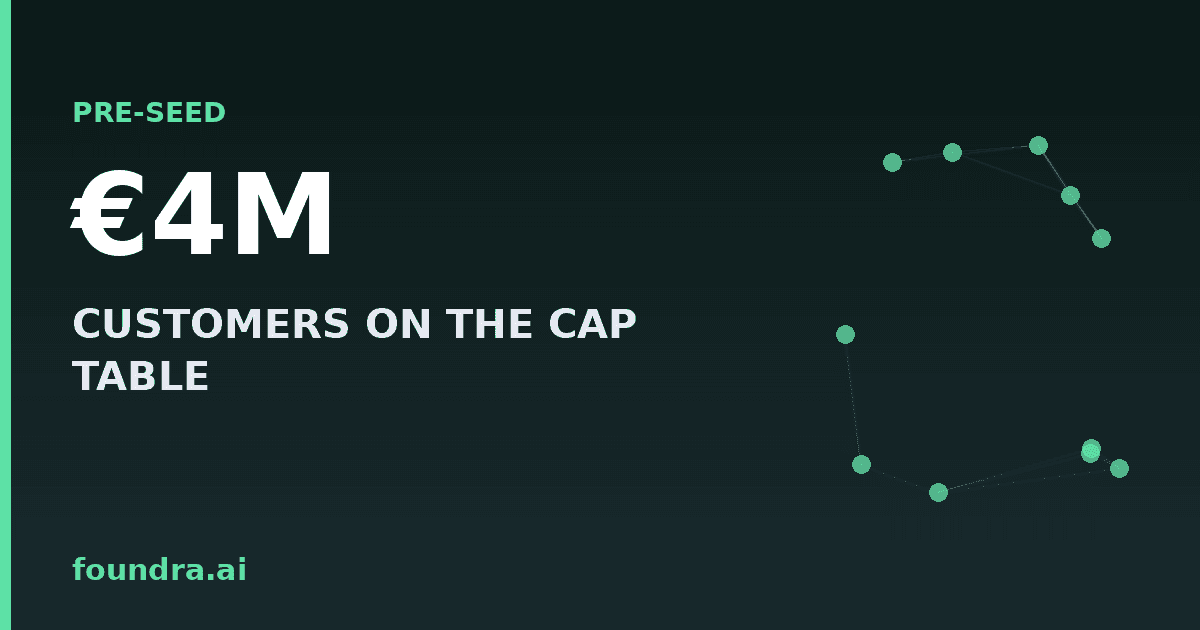
Backbone raised €4M pre-seed with two food manufacturers on the cap table. Customer-investors are showing up earlier than ever in 2026. Here is what they give you, what they quietly cost you, and how to structure the deal.
What happened on Backbone’s cap table?
Brussels-based Backbone announced a €4 million pre-seed on September 3. The product is a quality and compliance system for food factories: it pulls supplier certificates, lab results, ingredient specs and audit records into one place so a QA team can ask "show me every gluten test for this supplier this year" and get an answer instead of a spreadsheet hunt.
Interesting product. More interesting cap table.
Alongside the venture funds (Pitchdrive, PROfounders Capital, Passion Capital), two of the investors are Agristo and Darta. Both are food companies. Both are, in other words, exactly the kind of business that would buy Backbone's software.
That is not an accident, and it is not unique to Backbone. It is a pattern showing up across pre-seed and seed rounds in 2026. A customer on your cap table is not just a check. It changes how your company gets built, who trusts you, and who quietly stops returning calls.
Let's work through what you get, what it costs, and how to write the deal so it stays useful two years from now.
Why are corporates showing up this early?
Because the economics of finding good early-stage companies changed, and corporates noticed before most founders did.
The numbers are striking. Active corporate investors hit a record 3,068 globally, above even the 2021 peak, with dozens of new corporate venture units launched in the last year. Roughly a fifth of funding rounds now include a corporate investor, and by dollar volume more than half of startup capital in 2026 was deployed in rounds with a corporate participant. Crucially for founders reading this: about a third of corporate-backed rounds now happen at seed stage, a share that has held steady since 2022.
So this is not a late-stage phenomenon that will trickle down eventually. It is already at the pre-seed table.
Two forces drive it. First, corporates got burned buying startups late at inflated prices, and decided a small early check plus a commercial relationship is a cheaper way to get the same visibility. Second, in the current wave of vertical AI, domain knowledge is the scarce input. A food manufacturer knows things no amount of model training substitutes for. Investing is how they trade that knowledge for equity.
The September 3 funding day makes this legible. The rounds that closed were almost all vertical: insurance workflows, food compliance, enterprise data plumbing, orbital manufacturing. Generic model bets did not clear. Domain-specific ones did, often with a domain company attached.
What does a customer-investor actually give you?
Four things, roughly in order of how much they matter.
A design partner who cannot ghost you. Every early founder has had a friendly prospect who loved the demo, promised feedback, and vanished. An investor who is also a customer has a reason to answer the email. Backbone can walk a half-built feature into a real processing plant and watch someone try to use it.
Proof for the next customer. In conservative industries, the hardest sale is the first one. "Two established manufacturers backed us and run our software" collapses a nine-month procurement cycle into something survivable. Worth more than the check.
Vocabulary. Selling into food safety, insurance, or clinical workflows requires knowing which words signal competence and which mark you as a tourist. You can learn this over eighteen months of losing deals, or get it from someone on your cap table in a week.
Distribution, sometimes. Corporates occasionally open channels: a supplier network, an industry association, a conference slot. Treat this as a bonus, never the thesis. Channel promises made during a fundraise convert at a low rate.
What you do not get: a valuation premium, a faster next round, or an acquisition. Those are the fantasies founders attach to strategic money, and they are why strategic deals disappoint.
What does it quietly cost you?
Now the part that does not appear in the press release.
Signaling risk with the competitor set. If a food manufacturer owns a slice of you, their competitors will notice. Some will not care. Some will refuse to put supplier data into software partly owned by a rival. In a market with five large buyers, losing two of them is not a rounding error.
Roadmap gravity. Your customer-investor has specific problems. Their problems will feel urgent, will be well articulated, and solving them will feel like progress. Six months in you can be building a bespoke tool for one company while telling yourself you are building a product. This is the most common failure mode and it does not feel like failure while it happens.
Information rights that travel. Corporate investors often sit inside a parent company with a strategy team. Board decks and roadmaps can circulate further than you intended, sometimes to a group evaluating whether to build your product internally.
Acquisition anchoring. A strategic with any preferential right, even an informal expectation, can chill other acquirers. Buyers dislike bidding against an incumbent shareholder with better information.
Slower everything. Corporate legal moves at corporate speed. Budget weeks.
None of these are reasons to refuse. They are reasons to write the documents carefully.
Your AI co-founder is ready when you are.
Foundra turns everything in this article into an actual plan. Validation, customers, pricing, launch. In one place, in your voice, in an afternoon.
Get started→$39/month. Cancel anytime.
How do you structure it so it stays useful?
Five rules, learned mostly by watching founders skip them.
Keep the ownership small. Under 10% combined for all strategics at pre-seed and seed. Enough that they care, not enough that anyone else feels locked out.
Refuse exclusivity, in every form. No exclusive license, no category lockout, no right of first refusal on acquisitions, no pricing clause that constrains what you charge others. If a strategic requires exclusivity to invest, they are buying a supplier, not backing a company.
Separate the money from the contract. The investment agreement and the commercial agreement should be two documents signed at arm's length. Entangle them and a commercial dispute becomes a cap table dispute.
Cap the information rights. Standard investor reporting only. No sensitive detail flowing to a parent company's strategy team, and no observer seat for a strategic at pre-seed.
Write down what you will not build. Before the money lands, decide what share of engineering time can go to any single customer's requests. Twenty percent is defensible. Put it in your operating plan and revisit it monthly.
That last rule is a planning problem more than a legal one. You can hold it in a spreadsheet, a Notion doc, or a planning tool like Foundra that keeps roadmap and go-to-market decisions where you can see the drift. The mechanism matters less than looking on a schedule, because roadmap capture is gradual and invisible without a baseline.
When should you just say no?
There are cases where the right answer is a polite decline, and first-time founders take these deals anyway because a check from a recognizable company feels like validation.
Say no when the strategic wants exclusivity of any kind. Already covered, but it is the single most common poison pill and it is worth repeating.
Say no when they are your only realistic customer. If a market has three buyers and one invests, you have not raised a round, you have accepted a long consulting contract with equity attached.
Say no when the money arrives with a required integration into their existing systems. That is procurement dressed as investment, and it will consume two engineers for a year.
Say no when the terms are materially worse than a fund would offer and strategic value is the stated justification. Strategic value is real but not worth a broken cap table or board control.
And be careful when the strategic is a competitor to your future self. Nvidia's $12.9 billion acquisition of Hugging Face, announced the same week, is a reminder that today's supportive infrastructure partner can become tomorrow's owner of your category's default platform. That is not a reason to avoid strategic money. It is a reason to keep your dependencies portable and your ownership uncrowded.
The strongest position is boring: several small strategics, none dominant, all buying at commercial rates.
Key takeaways
Customer-investors are now normal at pre-seed. Around a third of corporate-backed rounds happen at seed stage. Backbone's €4M with two food companies attached is a template, not an exception.
The check is the least valuable part. Design partner access, credibility with conservative buyers, and industry vocabulary are what you are actually buying.
The real cost is roadmap capture. It happens slowly, feels productive, and is only visible if you set a baseline for how much engineering time any one customer can consume.
Exclusivity in any form is disqualifying. License, category, acquisition rights, pricing. All of it.
Keep strategics under 10% combined, and keep the investment and commercial agreements separate.
Diversity beats depth. Two or three small strategic holders is safer than one large one, especially in a market with few buyers.
If you take one thing from Backbone's round: it works because both strategics are small holders in a normal venture round led by actual funds. The structure is what makes the strategy safe.
Frequently asked questions
Should a first-time founder take money from a customer at all? Often yes, if the ownership is small, there is no exclusivity, and the commercial relationship is documented separately. The access to a real environment is hard to replicate any other way at pre-seed.
Will strategic investors hurt my chances with venture funds later? Usually not, if their stake is small and the terms are clean. Funds get uncomfortable when a strategic holds a large position, has special rights, or appears to control the roadmap. Those are the specific things to avoid.
Can they demand a discount because they invested? They can ask. Do not agree to a permanent one. Pilot pricing is fine. Structural discounts distort your unit economics and set a precedent every future customer eventually discovers.
What if the strategic wants a board seat? Decline at pre-seed. An observer seat is a maybe, a full seat is not. Board composition set in your first round follows you for a decade.
How do I tell real interest from a scouting exercise? Ask them to commit to a paid pilot with a start date before the round closes. Real interest survives that question. Information gathering usually does not.
Sources
- Backbone raises €4M to build the quality brain for the food industry (Backbone)
- Venture Capital & Startup Funding Roundup, September 3, 2026 (Tech Startups)
- Executive summary, World of Corporate Venturing 2026
- Global Startup Investment Hit Record $510B In H1 2026 (Crunchbase News)
- Q1 2026 PitchBook-NVCA Venture Monitor (NVCA)
You just read the theory. Ready to build the thing?
Foundra is your AI co-founder. It turns an idea into a validated business plan, a go-to-market, and your first 10 customers. In an afternoon, not a semester.
$39/month. Cancel anytime. Works in 20 languages.