Four Years Profitable. Then A $1.275B Pre-Money.
HubX bootstrapped to 40+ apps and 600M downloads before taking a dollar, then raised up to $75M from Point72 at a $1.275B pre-money. Here is what profitability actually buys a first-time founder at the negotiating table.
What actually happened with HubX on September 3?
A company most founders had never heard of just became Turkey's eighth unicorn without ever having raised a round.
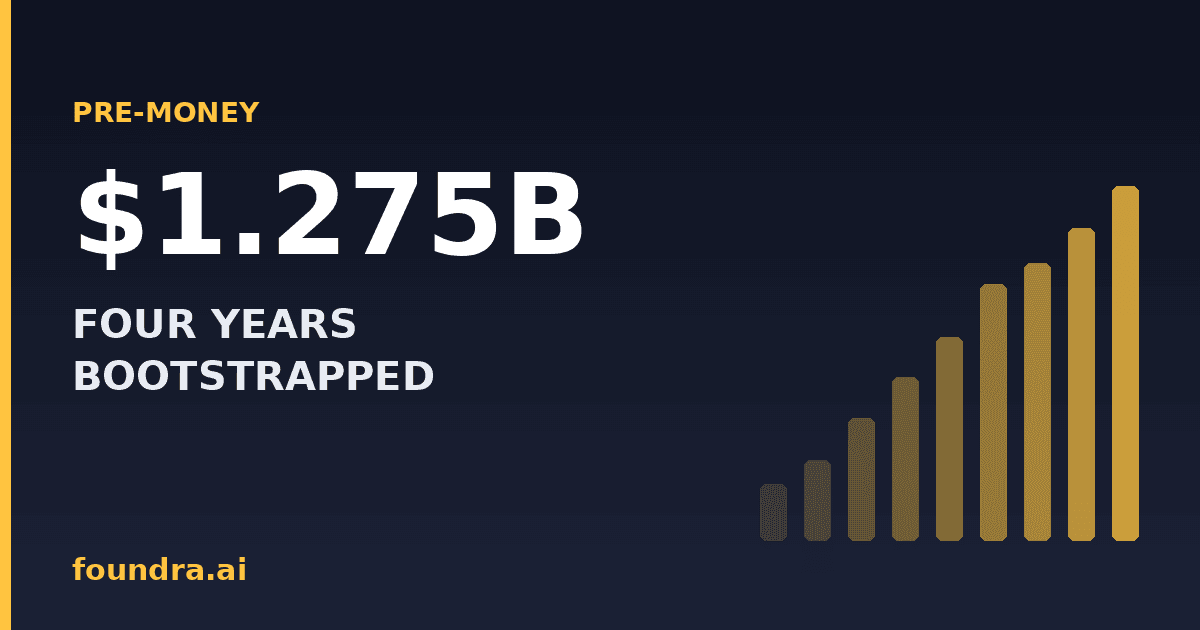
HubX, based in Izmir, announced on September 3 that it is taking up to $75 million from Point72 Private Investments at a $1.275 billion pre-money valuation. The structure matters: an initial $50 million, plus an option for a further $25 million. Before this, the company had taken zero outside capital since 2022.
What it built in those four years: more than 40 consumer apps, over 600 million downloads, distribution across 190-plus countries, and, by its own account, profitability. Founder Ekin Noyan is not describing a company that needed money to survive. He is describing one that decided money would speed up an acquisition strategy already running.
Here's why this matters even if you will never build an app portfolio. HubX is the clearest recent example of a founder walking into a negotiation with no gun to their head. That single fact changes almost everything, and most first-time founders never get to experience it.
Why does profitability change the terms you get offered?
Profitability changes terms because it removes the deadline. An investor negotiating with a company that has eleven months of runway is negotiating against a clock. An investor negotiating with a profitable company is negotiating against nothing.
Look at what HubX got. A $1.275 billion pre-money on a first institutional round is unusual, and it was reported as up to $75 million rather than a flat $75 million. The company kept a say in how much dilution it absorbs. Compare that to the typical first round, where the founder takes what is offered because the alternative is running out of cash.
Broader 2026 data points the same direction. Investors this year are scrutinizing net revenue retention above 100%, gross margins above 65% for software, and burn multiples under 1.5x far harder than they did in 2021.
So the metrics that make you fundable in 2026 are, mostly, the same metrics that make you not need funding. That is the central joke of modern venture capital. The people who can raise most easily are the ones who need it least.
The lesson is not "never raise." It is that every month you spend getting closer to default alive is a month you are buying leverage you cannot buy any other way.
What is the portfolio model, and should a first-time founder try it?
HubX did not build one product and hope. It started as a mobile app incubator, acquired and improved consumer apps across categories, and now runs more than 40 of them. Art tools, education, fitness, and lately generative AI features layered on top.
This is the portfolio model. Instead of a single large bet, you run many small ones, kill the losers fast, and reinvest cash from the winners.
It has real advantages. Variance drops. A dud costs you a quarter, not the company. And because each product is small, you can fund the next from the last one's revenue.
But let's be real about the tradeoffs, because they are severe for a first-time founder.
The portfolio model requires you to be excellent at one thing: cheaply acquiring users and monetizing them. Without that muscle, running 40 products just means being mediocre 40 times. It also fragments your attention at exactly the stage when focus is the only advantage a tiny team has. Most first-time founders who try this end up with a graveyard of half-launched things.
So: run one product until you can predict your acquisition and retention math. Then, and only then, does a second bet make sense. HubX ran this play for four years before anyone outside Turkey noticed.
What does a $50M now, $25M option structure actually mean?
Tranched rounds are common and widely misunderstood. Here is the plain reading.
An initial tranche plus an option means the investor commits capital in stages, with the second tranche tied to time, to milestones, or to the investor's discretion. Each version has different consequences.
Time-based is the friendliest. The money arrives on a date, and you can plan around it. Milestone-based is workable if the milestones are things you control, like shipping a product or hitting a revenue number. It becomes dangerous when milestones depend on external events you cannot influence, because you can miss them while doing everything right.
Investor-discretion tranches are the ones to read carefully. If the second tranche is entirely optional for the investor, you do not have $75 million. You have $50 million and a maybe. Plan your hiring and your burn against the money that is contractually certain, never against the headline number.
There is also a signaling dimension nobody warns you about. If the second tranche does not get called, the market reads that as the investor declining to double down. That can make your next round harder even if the company is fine.
None of this makes tranches bad. For a profitable company like HubX, an option to take more capital later is close to free optionality. For a company burning cash, the same structure can be a slow-motion trap. Same paperwork, opposite meaning.
Your AI co-founder is ready when you are.
Foundra turns everything in this article into an actual plan. Validation, customers, pricing, launch. In one place, in your voice, in an afternoon.
Get started→$39/month. Cancel anytime.
When is bootstrapping the wrong call?
Bootstrapping is not morally superior. It is a strategy with a fit range, and outside that range it will quietly kill your company.
Bootstrap when your product can generate revenue early, your acquisition cost is low or organic, your market is not being landgrabbed by a funded competitor, and you do not need expensive infrastructure before the first dollar arrives. Consumer apps, agencies, tools, and most B2B software with a self-serve motion fit here.
Do not bootstrap when the market is winner-take-most and someone else just raised $30 million to take it. Do not bootstrap when regulatory approval, hardware tooling, or a physical network has to exist before revenue is possible. Outlier Space, the New Zealand orbital manufacturing startup that raised a pre-seed the same day as HubX, cannot bootstrap. There is no scrappy version of putting a factory in orbit.
The test I'd use: can you get to a paying customer with the money in your bank account right now, plus a few months of your own time? If yes, bootstrapping is on the table. If no, capital is an input, not a choice.
One more thing. Bootstrapping only produces leverage if you actually reach profitability. A company bootstrapped for three years that still is not profitable has none of HubX's negotiating position. It just has a tired founder who owns 100% of something fragile.
How do you build the numbers that create optionality?
Optionality is not a mindset. It is four numbers you can recite from memory.
Contribution margin per customer. What is left after the direct cost of serving one customer. Without it, you do not know whether growth helps or hurts.
Payback period. How many months of that margin it takes to recover what you spent acquiring the customer. Under twelve months is healthy for most software. HubX's portfolio lives or dies on it.
Net revenue retention. What last year's cohort is worth this year. Above 100% means existing customers fund your growth.
Months to default alive. Cash on hand divided by net monthly burn, assuming no new revenue. This determines whether you are negotiating or begging.
Most first-time founders track exactly one of these, usually revenue, which is not on the list. Fixing that is a weekend of work.
If building the model is the blocker, you have options: a spreadsheet from scratch, a template from a firm like a16z or Bessemer, or a planning tool like Foundra that walks first-time founders through the financial and go-to-market sections in order. The tool matters far less than updating it monthly.
Then run one scenario you hope never happens: no funding for eighteen months. What do you cut, what do you charge, when do you break even? Founders who have that written down negotiate differently, and investors can hear it in the first ten minutes.
Key takeaways
The short version, if you skipped down here.
Leverage comes from not needing the money. HubX took four years and 600 million downloads to get there. The $1.275 billion pre-money is the output of that position, not the cause.
"Up to $75 million" is not $75 million. Read tranche triggers and plan against committed capital only.
The portfolio model is advanced. It requires distribution skill you earn on one product first.
Bootstrapping has a fit range. Revenue-early businesses can do it. Capital-intensive and landgrab markets cannot.
Four numbers create optionality: contribution margin, payback period, net revenue retention, and months to default alive.
Profitability is a negotiating instrument, and the only one you can build without anyone's permission.
The reason HubX is interesting is not that it is worth $1.2 billion. It is that the founder got to decide when the conversation happened.
Frequently asked questions
Does bootstrapping mean I should never talk to investors? No. Talk to them early and often, just do not ask for money. Investor conversations are free market research and build the relationship you want later. You are informing, not pitching.
How long should I bootstrap before raising? A useful trigger: raise when capital would let you do something you have already proven works, faster. Raising to discover whether something works is a weaker position.
What is a normal pre-money for a first institutional round? It varies by sector, geography, and traction. HubX's $1.275 billion is an outlier driven by profitability and scale. Most first rounds land far lower, and comparing yourself to a headline number is a good way to price yourself out of a deal you needed.
Is a tranched round a red flag? Not by itself. It is a red flag when the second tranche is at the investor's discretion and your plan depends on it. Structure the plan around the first tranche and treat the rest as upside.
What if I am not profitable and cannot get there soon? Focus on the next best leverage: a short, credible path to a milestone that changes the company's risk profile. Investors will fund a clear next step, not a vague one.
Sources
- HubX Raising Up to $75 Million from Point72 Private Investments (HubX)
- HubX becomes Türkiye’s 8th unicorn (Daily Sabah)
- HubX Raising Up to $75M at $1.275B Pre-Money Valuation (FinanceWire via Investing.com)
- Venture Capital & Startup Funding Roundup, September 3, 2026 (Tech Startups)
- HubX Raises $75 Million Series A To Become Turkey’s 8th Unicorn (Ventureburn)
- The State of VC Funding in 2026 (Value Add VC)
You just read the theory. Ready to build the thing?
Foundra is your AI co-founder. It turns an idea into a validated business plan, a go-to-market, and your first 10 customers. In an afternoon, not a semester.
$39/month. Cancel anytime. Works in 20 languages.