Median Product Lifespan Fell to About 18 Months. Users Noticed.
SaaSHub tracks hundreds of thousands of products. Its data shows median lifespan dropping from roughly four years to roughly 1.5 years during 2026. Meanwhile median B2B SaaS churn sits near 3.5 percent a month. Here is what both numbers do to a first-time founder’s plan.
The number, and where it comes from
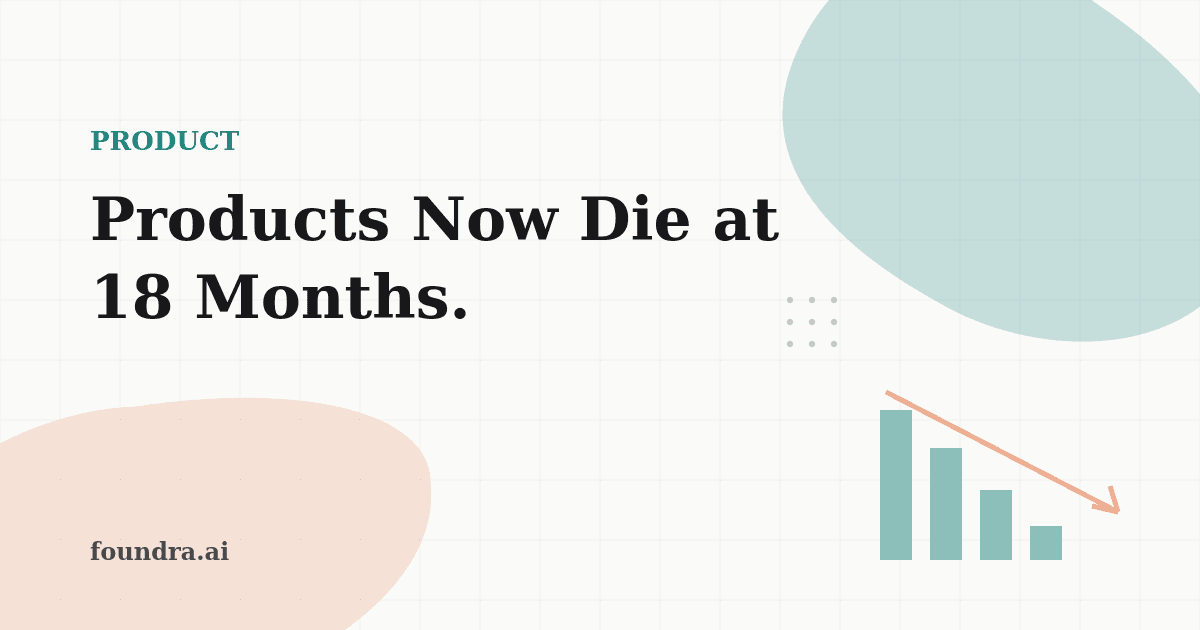
SaaSHub maintains a product graveyard, a running record of software products and whether they are alive. It covers hundreds of thousands of them. For years the median lifespan of a product that died sat around four years. In 2026 that figure fell to roughly 1.5 years.
The site's founder posted the finding to Hacker News in late October 2026, where it collected 92 points and a long argument. The sharper cut of the data is this: products that shut down in the most recent twelve months lived a median of 2.7 years, against 4.2 years for products that shut down three years earlier. That is a 36 percent drop in how long a product survives before someone turns it off.
One caveat deserves to go near the top, because a commenter raised it immediately and it is fair. Some of this is composition. Nothing launched in 2025 or 2026 can yet be four years old, and far more products are launching now than before. A flood of young products mechanically pulls a median down. The effect is real. It is also unlikely to explain a drop this size on its own.
What changed in 2026
The explanation offered by SaaSHub's founder is that software has become too cheap to produce. People build, launch, discover there is no demand or no way to reach it, and walk away. Experiments that used to cost six months of nights and weekends now cost a weekend, so far more happen and far more get abandoned.
The Hacker News thread argued about this hard, and the disagreements are more useful than the headline. One developer pointed out that if nobody wants the software, distribution is not the binding constraint, quality is. Another argued that maintenance, support and marketing were never made cheap by better tooling, only initial construction was, so people reach the unglamorous part and quit. A third observed something quieter: launching, getting ignored, and moving on skips the phase where a founder learns anything, so the next attempt is no better informed than the last.
The common thread is that the expensive parts of building a business did not get cheaper. Only the first mile did.
The cost nobody puts on the balance sheet
The most important consequence shows up on the other side of the transaction.
A commenter on that thread described a rule he now applies to software: he will not adopt anything that has not been actively supported for at least three years. He compared it to not starting a television series until it has three seasons. Another said he has stopped signing up for new tools because he no longer trusts anything will exist in six months. A third described retreating to established software and building small personal tools for everything else.
Read that as market research. Every abandoned product raises the switching cost for the next one. Your prospect has been burned, has migrated data out of two dead tools this year, and is applying a survival filter you did not know was there. When they hesitate on your signup page, you will log it as a pricing objection or a feature gap. It may be neither. They may be asking whether you will still be here in a year, and you have given them no way to answer.
This is a negative feedback loop. Products die young, users get cautious, new products find adoption harder, more products die young.
TruckSmarter gave 500,000 carriers three days
An example with real people in it. TruckSmarter, founded in San Francisco in 2021 by a DoorDash and Uber Freight alumnus and a former Plaid engineer, ran a free load board plus a paid dispatch product for truckers. More than 500,000 carriers used it.
On Tuesday, September 1, 2026, the company emailed customers to say it had been acquired and the app would shut down that Friday, September 4. Three days. Active dispatch subscriptions were cancelled, with invoices from the previous 30 days refunded. Neither the company nor the trade press named the buyer, and analysts speculated the acquirer wanted the engineering team rather than the freight platform.
Set aside whether the deal was good for the founders. Consider the owner-operator who routed his week's loads through that app. He got three days to rebuild his workflow, and he will remember. The next freight software startup that calls him is selling into that memory, and it does not matter that they were not the ones who did it.
Shutting down well is part of the job. So is being visibly durable while you are alive.
Your AI co-founder is ready when you are.
Foundra turns everything in this article into an actual plan. Validation, customers, pricing, launch. In one place, in your voice, in an afternoon.
Get started→$39/month. Cancel anytime.
What normal churn actually looks like in 2026
Founders consistently misjudge whether their retention is bad, so anchor on published benchmarks.
The 2026 median monthly churn for B2B SaaS is about 3.5 percent, with a wide spread by segment: under 1 percent at the enterprise end, up to 9.6 percent in categories like education technology. That 3.5 percent splits into roughly 2.6 percent voluntary churn, meaning customers who chose to leave, and 0.8 to 0.9 percent involuntary churn from failed payments and expired cards. Recurly's July 2026 data puts median annual SaaS churn between 3.04 and 3.22 percent, with the top quartile at 1.78 percent or better.
Two practical reads. First, close to a quarter of typical churn is a billing problem, not a product problem. Dunning emails, card-update prompts and retry logic are unglamorous work that recovers revenue you have already earned. Second, if your monthly churn is 8 percent and you are selling to small businesses, you are not necessarily failing. If it is 8 percent and you are selling to enterprises, something is wrong and it is probably onboarding.
What to build when features are nearly free
If anyone can assemble features quickly, features stop being the moat. What is left is slower to copy.
Distribution, meaning a channel where people already trust you: a list, a community, a search position, a partner who resells you. Data that accumulates with use, so a year-old customer cannot be served as well by a copy of your product. Integrations and workflow depth, because being wired into six other systems is tedious to replicate. Trust signals, cheap and mostly ignored: a changelog with real dates, an uptime page, named humans, an export button that works.
And a commercial model that works at your real scale. One commenter captured the trap precisely: founders release a product, fail to get millions of users immediately, and abandon it. A product with 60 paying customers and 90 percent annual retention is a business. It only looks like failure against a benchmark that was never yours. Deciding what scale your business actually needs to work, before you measure yourself against someone else's, is the kind of groundwork Foundra walks first-time founders through, because the wrong target produces a premature shutdown more often than a bad product does.
The honest counterargument
Not everyone on that thread read the data as bad news, and the dissent is worth keeping.
One view: a faster fail rate can indicate a healthy market where bad ideas get killed quickly instead of limping along for four years burning capital and founder health. Another: the median says nothing about the absolute number of successes. If total launches are up sharply, you can have more products succeeding while median lifespan falls, because failures grew faster.
There is also the composition argument from earlier. And a prediction that may prove wrong: that users will build their own tools with AI instead of buying. A commenter pushed back that this is a technologist's fantasy, that most people have no interest in building or maintaining software and would rather pay someone. An HVAC company is not going to write its own CRM. That seems right for most markets, which is reassuring if you sell to businesses that are not software companies.
The defensible conclusion is narrower than the headline: product lifespans are falling, buyer caution is rising as a result, and the burden of proving durability has shifted onto you.
A durability checklist before launch
Six things to settle before you ship, each of which a prospective customer can see.
Write down the number of paying customers at which this business sustains you, and the date by which you will know whether you can get there; vague ambition is what produces abandonment at month nine. Publish a changelog with dates from the first week, so a visitor in month six can see you are still here. Make data export real and documented, which lowers the cost of trying you. Fix involuntary churn before you optimise anything else, because a quarter of your losses are expired cards. Name a human on your site, since anonymous products read as temporary. And decide in advance what a responsible shutdown looks like, including how much notice you would give. Nobody ever regretted giving 90 days instead of three.
None of this is product work. All of it answers the question your buyer is now asking before they ask about features.
Frequently asked questions
Is the fall in product lifespan definitely real? The trend is real in SaaSHub's data, with a 36 percent drop between recent and older cohorts. Part of the effect comes from a surge of young products pulling the median down. Treat the direction as reliable and the exact figure as approximate.
What counts as good churn in 2026? The B2B SaaS median is around 3.5 percent monthly. Enterprise sits under 1 percent. Small business and consumer categories run much higher. Compare yourself to your segment, not to the overall median.
How much of my churn is a billing problem? Typically 0.8 to 0.9 points of a 3.5 percent monthly rate, so roughly a quarter. Card-update prompts, retry schedules and clear dunning emails recover a meaningful share of it.
Does this mean I should not launch a small software product? No. It means features alone will not hold anyone, and your buyer is actively screening for whether you will still exist. Build the trust signals early and they cost almost nothing.
Will customers really just build their own tools with AI? In narrow cases, yes, and simple calculators are being absorbed into general assistants. For most businesses outside software, the appetite to build and maintain internal tools is low.
What is the highest-leverage thing to fix first? First-week onboarding and payment recovery. Both affect retention immediately, both are cheap, and neither requires a new feature.
You just read the theory. Ready to build the thing?
Foundra is your AI co-founder. It turns an idea into a validated business plan, a go-to-market, and your first 10 customers. In an afternoon, not a semester.
$39/month. Cancel anytime. Works in 20 languages.